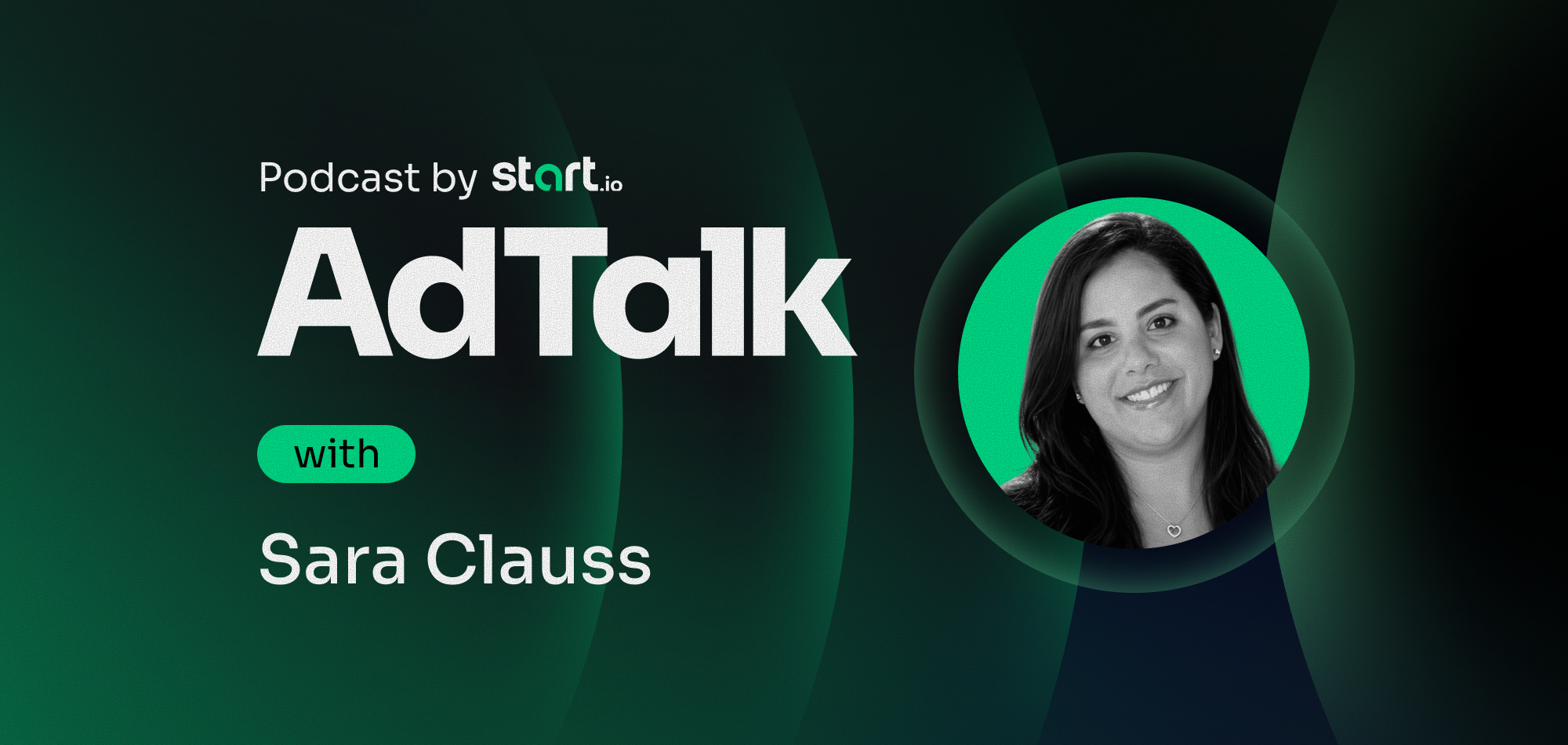
TL;DR
Sara Clauss from Nimbus shares insights from nearly 12 years in AdTech, exploring programmatic advertising, AI, privacy, and the future of mobile apps and CTV. She discusses why asking the right questions, understanding performance data, and building flexible, transparent partnerships are key to success.
Sara Clauss, Director of Demand Operations & Accounts at Nimbus
🎧 Audio version is available exclusively on Spotify:
Briefly introduce yourself, your role, and the pivotal moment in your career that led you to AdTech.
AdTech is actually my third career. I started out working with my family in the diamond business, while going to graduate school at night for my master’s in psychology. I knew I wanted to work with people and do something that made a difference, so after graduating, with a focus on mental health and substance abuse, I spent about six years working with the homeless population across several nonprofit organizations.
That experience had a huge impact on me and helped shape who I am today, but after six years I found myself at a crossroads. I started thinking about where I wanted my career to go and realized I was ready for a change, but I still wanted to find a way to work with people and build relationships.
I stumbled across an opportunity at a small desktop video SSP startup and decided to take a chance on something completely new. I told myself I’d give it a year and see if AdTech was the right move. Almost 12 years later, I think it’s safe to say the year worked out.
What’s funny is that on paper, my three careers couldn’t look more different, but the skills I developed along the way translate more than you would think. AdTech is ultimately a relationship business, and understanding people, how they communicate and what motivates them has been invaluable throughout my career.
What is an underrated tool, habit, or soft skill that has become indispensable to your daily work?
Asking questions. A lot of them.
AdTech gets complicated very quickly, and I think there can sometimes be pressure to sound like you already know the answer. I’ve found the opposite is usually more valuable. I want to understand why something is happening, not just know that it happened.
That applies internally, with partners and especially when troubleshooting. If spend drops, a connection isn’t scaling or the numbers don’t line up, I’m going to keep asking questions until I understand what’s actually happening. More often than not, that’s how you uncover the real problem.
What is one common misconception about programmatic or AdTech that you find yourself constantly correcting?
That programmatic is completely automated.
Yes, the transactions happen in milliseconds, but there are a tremendous number of decisions, relationships, integrations and optimizations behind those milliseconds. You don’t just turn on a connection and watch revenue appear.
Two integrations using the same technology can perform completely differently depending on the inventory, GEOs, formats, buyers, pricing and how each side is configured. The technology facilitates the transaction, but there are still people behind it making decisions that ultimately determine performance.
What are your platform’s three biggest priorities right now, and why do they matter for the broader ecosystem?
For us, I’d probably group them into three areas: transparency, efficiency and creating more paths between quality supply and demand.
The industry has spent years adding layers. I think the next phase is about making those layers work smarter. Publishers need to understand where their revenue is coming from, buyers need confidence in the inventory they’re purchasing, and everyone needs infrastructure that can make those connections efficiently.
At Nimbus, a lot of our focus is on giving publishers more flexibility in how they access demand while making those connections as effective as possible. Ultimately, if publishers have more control and buyers have better access to quality inventory, both sides benefit.
Based on your experience, what is the #1 “best practice” most companies overlook when trying to succeed in programmatic?
Understanding why something works.
People understandably focus on the end result: revenue went up, spend went down, this partner is performing, that one isn’t. But if you don’t understand what is driving the result, it’s very hard to recreate success or fix a problem.
I’m a big believer in looking beyond the top line number. Which GEOs are working? Which apps? Which formats? Which demand paths? What changed?
The more you understand what’s underneath the number, the more actionable the data becomes.
Which specific industry regulation or privacy change is currently having the biggest impact on your 2025/2026 strategy?
Privacy is obviously shaping almost every part of the ecosystem, but I think the bigger strategic shift is that we can no longer build around the assumption that there will always be a universal identifier available.
Whether it’s regulation, platform level privacy changes or consumer expectations, the direction is clear. The industry has to get better at creating value from signals that are available and privacy conscious rather than constantly trying to recreate what existed before.
For us, that means making sure our infrastructure can support different identity and targeting approaches without becoming dependent on any single solution.
Without giving away trade secrets, can you share a recent project or case study that highlights a creative solution to a tough AdTech problem?
A lot of the wins I’m most proud of don’t come from one big change. They come from taking a partnership that isn’t performing the way we expected and figuring out why.
We recently had a situation where we knew there was significantly more potential in a partnership, but the initial performance wasn’t reflecting it. Instead of assuming it was a demand or inventory issue, we looked across the entire setup, the data, the integration, how the traffic was being routed and where there might be gaps between the two sides.
We were able to identify several areas that were limiting performance, make changes and ultimately grow the partnership.
I think it’s a good example of something I’ve learned in AdTech: when something isn’t working, the answer usually isn’t just “find more demand.” Sometimes the biggest opportunity is figuring out what’s preventing the demand you already have from working the way it should.
We know AI is everywhere. Where specifically do you see it providing the most practical value for identity and targeting today?
For me, the most practical value of AI right now is its ability to find patterns across huge amounts of data much faster than a person ever could.
As the industry moves away from relying so heavily on traditional identifiers, understanding how different signals work together becomes much more important. AI can help identify relationships between those signals and performance that would be incredibly difficult to uncover manually.
I don’t think AI replaces strategy or human decision making, but it can make the people making those decisions dramatically faster and better informed.
Which specific niche or sub-sector of AdTech would you bet on for the most rapid growth right now?
I still think there’s a lot of growth ahead in mobile app and CTV, but what I find most interesting is how much more sophisticated those environments are becoming.
For a long time, different channels were treated almost like separate businesses, with different buyers, different technology and different strategies. That’s changing. Advertisers increasingly want to reach audiences across environments, and publishers want to make their inventory accessible to as much quality demand as possible.
I think the real growth opportunity is in making those connections easier. The companies that can remove some of the complexity between buyers and publishers while still giving both sides control are going to become increasingly valuable.
What is a “hidden gem” opportunity currently opening up for advertisers or publishers that most people aren’t talking about yet?
I think flexibility is becoming much more valuable than people give it credit for.
For a long time, AdTech has been focused on building the perfect solution or the perfect path between buyers and publishers. I’m not sure there is one anymore. Publishers have different inventory, different priorities and different ways they want to work with demand. Buyers are just as varied.
I think the opportunity is in building technology and partnerships that can adapt to those differences instead of forcing everyone into the same model. The more flexible the ecosystem becomes, the easier it is to create connections that actually make sense for both sides.
To me, that’s where a lot of the next wave of innovation will come from. Not necessarily another new piece of technology, but finding smarter and more flexible ways to use the technology we already have.
Share one book, podcast, or article that has fundamentally shifted your perspective on business or technology recently.
I’m going to cheat slightly on this one because the biggest influence on how I approach business didn’t come from a business book.
My background in psychology and social services taught me to listen to what people are actually saying, understand what motivates them and recognize that two people can look at the exact same situation and see something completely different.
Technology changes constantly. Platforms change. Companies change. But businesses are still ultimately made up of people. That perspective has probably influenced my career more than any single book or podcast.
Is there anything else you’d like to share, or a question you wish we had asked you today?
Maybe: “What keeps you in AdTech after almost 12 years?”
For me, it’s that the industry never really stands still. There’s always another problem to solve, another technology to understand and another relationship to build. You can spend more than a decade in AdTech and still find yourself learning something new all the time.
I originally gave myself one year to see if this industry was right for me. Almost 12 years later, I’m still learning, still being challenged and still enjoying it. I think that says a lot.