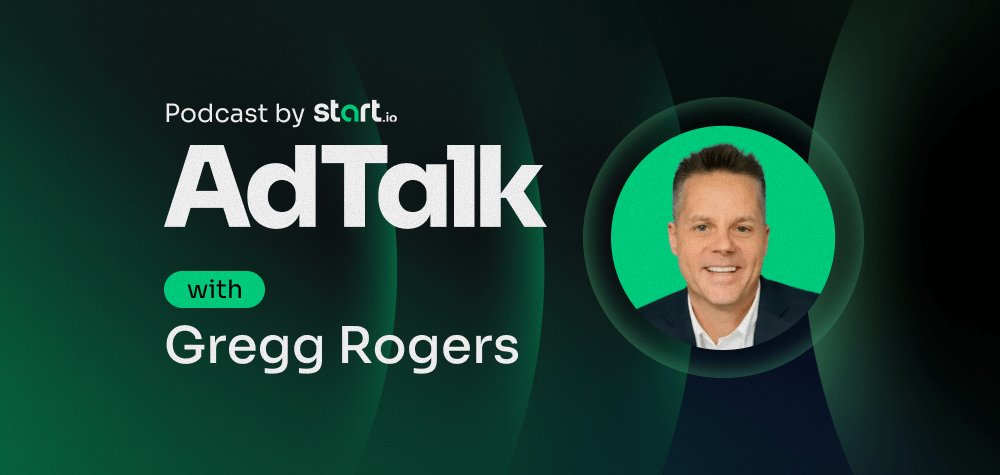
Gregg Rogers, Senior Director, Business Development – Platform Partnerships, Media.net
🎧 Audio version is available exclusively on Spotify:
Briefly introduce yourself, your role, and the pivotal moment in your career that led you to AdTech.
I’m excited to share my next chapter: I’m kicking off 2026 by joining the team at Media.net at advertising’s premier event at CES as Senior Director, Business Development – Platform Partnerships. This new role on Media.net’s marketplace team will focus on growing enterprise Curation & Media Networks revenue by expanding DSP and platform partnerships, leveraging Media.net’s search-intent contextual signals and its agentic AI–powered SELECT curation offering.
Most recently, I’ve led LoopMe’s self-service sales team for Programmatic Curation & Platforms, centered on predictive AI and performance-driven outcomes.
Prior to this, I’ve led the Curation partnerships sales team at Equativ building out one of the first to market curation platforms.
My career in advertising began at a local television station, News 12 during the dot-com era, then grew across Cablevision/Altice, where I progressed from production to senior roles spanning product, operations, and cross-functional ad operations supporting brands including Newsday, News12, and Optimum. In 2009, while on the Cablevision Media Sales team running our first set-top-box addressable campaign, I saw how creativity, hyper-local targeting, measurable impact, and storytelling could come together—and that was the moment I realized advertising technology was something I wanted to keep building for customers. After 15+ years working and running teams across product, ad operations, and sales roles, I later joined NBCUniversal, leading video ad delivery and product initiatives across major properties—deepening my expertise in SSAI/DAI and CTV—and worked on projects tied to SNL, NBC Sports, Golf Channel, NASCAR, and the Rio Olympics. In 2017, I joined Sizmek, owning GTM for in-stream video products for CTV and digital audio. I also held other senior publisher, consultancy adtech roles in the Pharma / Healthcare and data space building out Advanced TV and programmatic channel partnerships and consulting and advisory roles in pub dev, data and martech driving revenue growth. Much of expertise in data signals, HIPAA compliance, GDPR are as a result of learning the many targeting regulations in the field of Healthcare.
I’m grateful for the journey building, creating and innovating for my marketing customers—and excited for what’s ahead.
The Hidden Weapon: What is an underrated tool, habit, or soft skill that has become indispensable to your daily work?
First, as most of our day-to-day work on GMeet uses AI apps to capture key meeting notes, it’s fundamental to also build a lightweight written operating system or process for the team: crisp next steps, owners, dates, and decision rationale—every single time. Secondly, in advance of any significant client meeting(s), I like to connect & align with key peers / internal team members to get the tough questions and objections out of the way before the meeting, so the meeting can be quick and productive…
The Industry Myth: What is one common misconception about programmatic or AdTech that you find yourself constantly correcting?
One myth I’m always correcting is that programmatic is basically set-it-and-forget-it automation. In reality, it’s a feedback system—so it will optimize perfectly… for whatever signal you give it and whatever inventory you allow it to buy. If your goal is fuzzy, your measurement is weak, or your supply path isn’t controlled, you can get ‘great’ CPMs and CTRs with zero business impact. The winners treat programmatic like an operating system: clear outcomes, clean data, curated supply, strong guardrails, and continuous creative testing. Simply, Programmatic is the power steering, not an autopilot. It makes you faster and more efficient — but only if you keep your hands on the wheel.
Top Priorities [at Media.net]: What are your platform’s three biggest priorities right now, and why do they matter for the broader ecosystem?
1. Proving performance (better measurement + outcomes) So buyers can justify spending and optimize to real results, not just clicks/impressions.
2. Privacy-safe targeting using context + signals So campaigns still reach the right people as cookies fade and regulation tightens.
3. Curation + cleaner supply paths (SPO, fewer hops, more control) So buying is more transparent, efficient, and higher quality for both advertisers and publishers. Formats like vertical video via Media.net’s Bytes offering when paired with curation strategies, can deliver stronger outcomes for advertisers with more engaging narrative and less disruptive experiences.
In summary, these priorities reflect a broader shift toward fewer, higher-quality transactions that align performance, privacy, and user experience across the open internet.
The Success Blueprint: Based on your experience, what is the #1 “best practice” most companies overlook when trying to succeed in programmatic?
The most overlooked best practice in programmatic is creating one reliable “source of truth” that links delivery, quality, outcomes, and profitability from start to finish. Too often teams rely on disconnected dashboards that show spend and top-line KPIs, but don’t clearly connect where ads actually ran, whether the supply was legitimate, whether results were truly incremental, what the all-in costs were after fees and discrepancies, and what margin was actually delivered. When you connect the full chain—from bid and win through impression, outcome, and billing—you can make faster, better decisions on SPO, scaling deals, pricing, and partner strategy, and you avoid unpleasant surprises when invoicing and margin don’t match what the dashboards suggested.
The Growth Engine: Which specific niche or sub-sector of AdTech would you bet on for the most rapid growth right now?
If I had to bet on one AdTech niche for the fastest growth right now, it would be commerce media—especially retail media and “offsite” retail media. Retailers have an edge most publishers don’t: actual purchase data and a clear way to tie ads to sales. That makes ROI
easier to prove, so more budget keeps flowing into retail media—even as targeting gets tougher in other channels. Using retailer audiences beyond the retailer’s own site, and reaching people across the open web and CTV through programmatic. That’s how retailers—and brands—get more scale.
Bottom line: it’s growing fast because it’s measurable, backed by real data, and built for performance.
What is a “hidden gem” opportunity currently opening up for advertisers or publishers that most people aren’t talking about yet?
Advancements by IAB to standardize programmatic deal sync & automation though Deals API is definitely a hidden gem marketers should be leaning into. Albeit many SSP marketplaces support APIs today, programmatic deals are still surprisingly hands-on—deal IDs get entered wrong, SSP and DSP settings don’t line up, and delivery falls short for issues that shouldn’t happen. The Deals API aims to keep deal information consistent across platforms, reducing breakage and making it clearer who created, packaged, and curated each deal. A standardized Deals API is a key step toward making sell-side decisioning more transparent, consistent, and trustworthy.
AI Beyond the Hype: We know AI is everywhere. Where specifically do you see it providing the most practical value for identity and targeting today?
From a contextual SSP standpoint, AI matters most when it makes context a reliable targeting signal—even when identity is scarce. First, it helps us understand content in a much richer way than keywords alone, including topic, sentiment, brand suitability, and especially intent—so we can tell the difference between someone browsing travel articles and someone actively planning a trip. Second, it enables scalable contextual segments that align to advertiser objectives—like in-market behaviors, lifestyle interests, or real-time “moments”—without depending on third-party cookies. Third, it improves sell-side decisioning by identifying which impressions should flow into which curated packages or PMPs and matching that supply to the right buyers based on predicted performance and quality. And it also builds trust by detecting IVT, spoofing, and other quality issues so buyers see cleaner supply. When consented addressable signals are available, AI can validate and refine them—but the main win is stronger outcomes powered by privacy-safe contextual intelligence.
Is there anything else you’d like to share, or a question you wish we had asked you today?
As we enter into 2026, the trends I’m most focused on are where AI, privacy, and performance accountability converge. AI is going from small tests to everyday use that’s expected to show real results. It can help with everything from writing a brief to launching and improving campaigns, but the teams that do best will move fast while still keeping clear rules, good tracking, and people checking the work. At the same time, privacy rules are getting stricter, so marketers are relying more on their own customer data and safer ways to target ads. And to figure out what’s really working, they’re using more lift tests and marketing mix modeling to measure results across all
channels. Curation and sell-side decisioning will reshape programmatic in 2026 by shifting focus from IDs to real audiences, pairing AI automation with human judgment, and pushing for simpler, more transparent SPO stacks and outcomes that work across channels like CTV and commerce media and partners. Finally, I think we’ll see companies cut down on too many marketing tools, and pay more attention to how AI is changing the way people find information—so marketers will focus on showing up in AI-generated answers and building direct relationships with their own audiences. Overall, 2026 is about using fewer tools, keeping cleaner data, and making sure marketing spend clearly drives real business results.